Even 12 + 12 Split
Frames 01–12: Head rotates evenly left to right (2 degrees per frame). Frames 13–24: Head rotates evenly back. Result: Looks like an oscillating desk fan.
Imagine someone in your group chat announces they are baking sourdough at 11:45 PM on a Tuesday. You want to reply with a character slowly blinking in quiet concern. If that blink happens on frames 1, 2, and 3 and immediately loops, it looks like the character has dust in their contact lens. If the eyes stay wide open for 20 frames, snap shut for 4, and hold half-closed for 12, it reads as a dry philosophical verdict.
In short-form animation, drawing skill is optional, but arithmetic is mandatory. Let us break down how animators use exposure sheets (X-sheets), twos and ones, and hidden loop seams to engineer comedic rhythm.
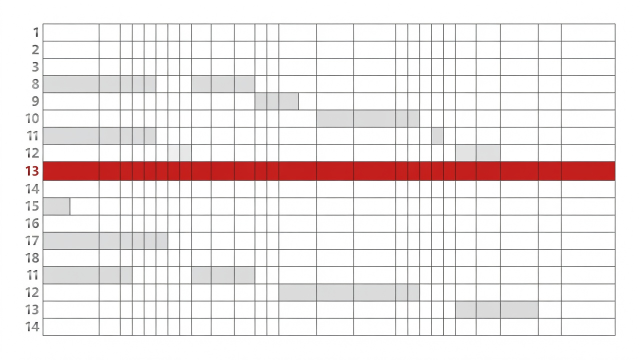
Beginners often let software interpolate evenly between Pose A and Pose B. As Harold Whitaker and John Halas explained in their 1981 handbook Timing for Animation, mechanical ease-in/ease-out feels weightless and polite—which is the exact opposite of funny. Comedy thrives on contrast: a long stretch of near-total stillness interrupted by a sudden, decisive snap.
Compare the two 24-frame recipes on the left. Both begin and end in the exact same posture, yet Recipe B lands the joke because it starves the viewer of motion for the first half-second, making the two-frame smear feel earned.
Frames 01–12: Head rotates evenly left to right (2 degrees per frame). Frames 13–24: Head rotates evenly back. Result: Looks like an oscillating desk fan.
Frames 01–16: Zero movement except a 1-pixel pupil shift. Frames 17–18: Motion-blurred crimson smear. Frames 19–24: Rigid settle with tiny overshoot.
Every looping clip has a seam where the final frame hands control back to Frame 01. You have two honest ways to handle that boundary. In a Ping-Pong or Seamless Cycle, Frame 24 eases directly back into the geometry of Frame 01, creating hypnotic perpetual motion—ideal for simmering impatience, tapping fingers, or endless coffee pouring.
In a Hard-Cut Reset, you let the action escalate to an absurd peak on the final frame and deliberately slam straight back to deadpan calm on Frame 01. That abrupt jump cut becomes part of the joke, mimicking how quickly we pretend everything is fine in a group chat.
Establish neutral posture for at least 350 milliseconds so the eye anchors.
Move 3 pixels in the opposite direction of the main take (the wind-up).
Cross the distance in 2 frames using a stretched silhouette.
Hold the final expression long enough for the viewer to smile before reset.
About cookies We use necessary cookies to run the site and, with your consent, optional ones to measure visits. You can change this at any time. More about cookies